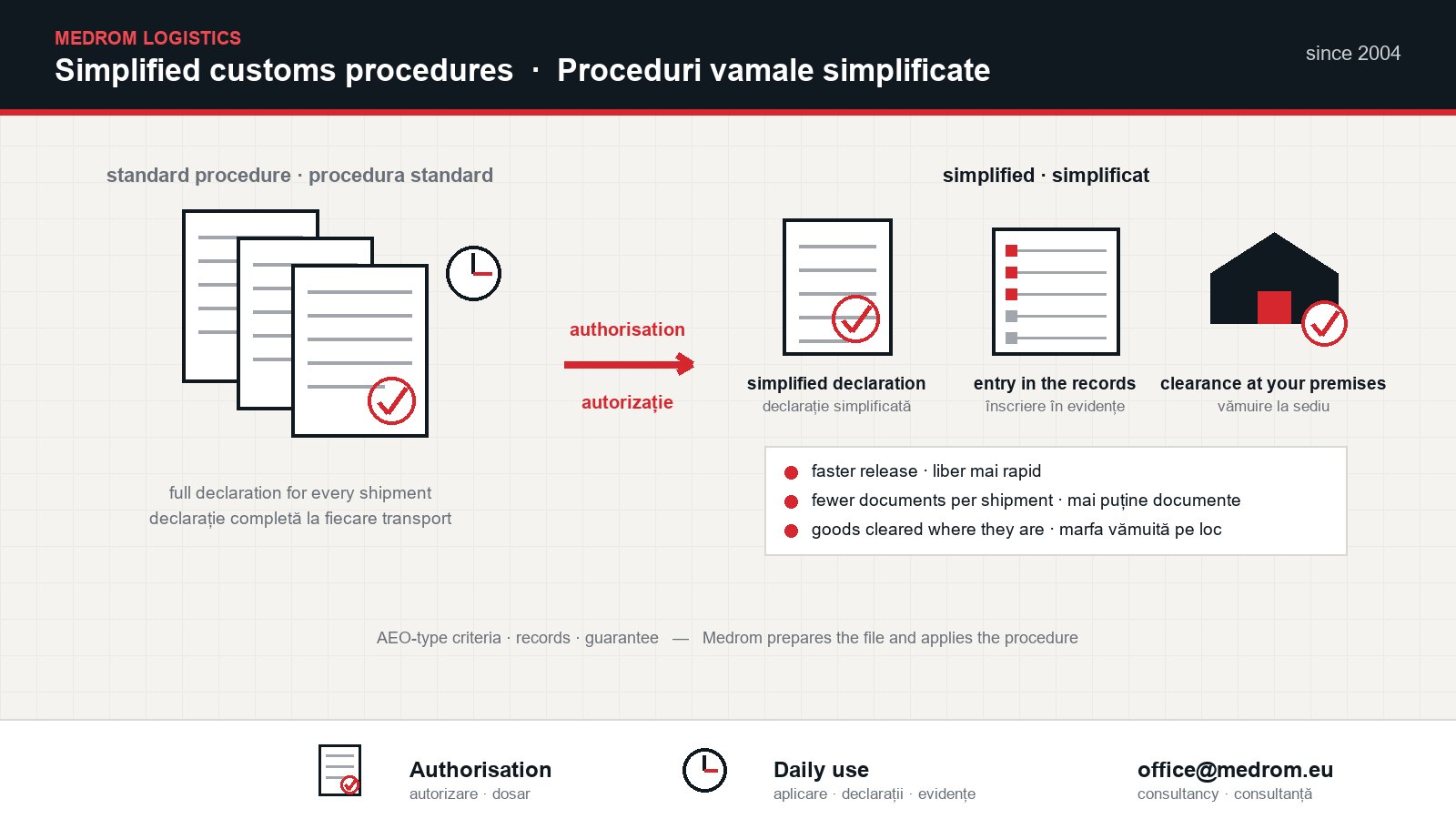
The simplifications available
- Simplified declaration — the goods are released on a declaration with reduced data or without some supporting documents, and the supplementary declaration is lodged later, within the period set by customs. Useful when the full commercial documents arrive after the goods, or when many shipments can be grouped in one supplementary declaration.
- Entry in the declarant's records (EIDR) — the customs declaration is replaced by an entry in your own electronic records at the moment the goods arrive at or leave your premises; customs is notified and may waive presentation of the goods. This is the basis of what is usually called clearance at your premises: the truck is unloaded at your warehouse, not at the customs office.
- Authorised locations and approved premises — your warehouse or plant is approved as a place where goods can be presented and released, so that transit operations end and start at your door.
- Other simplifications — depending on your flows: centralised clearance across several customs offices, simplifications for specific regimes such as customs warehousing or inward processing, and the use of a comprehensive guarantee with reduced amounts. We tell you which ones actually pay off for your volumes.
What the authorisation requires
Simplifications are granted by the customs authority on application and are based on trust: customs gives up part of its control at the border because it can verify your records afterwards. The conditions are therefore similar to those for AEO status — a record of compliance with customs and tax rules, an accounting and logistics system that lets customs trace each shipment, and, for some simplifications, a guarantee for the duties at stake. A company that already holds AEO authorisation meets most of these criteria automatically; a company that does not can still qualify, but the file must show the same level of control.
The authorisation can be held by your company or, for some simplifications, by your customs representative acting for you. We advise which solution is right in your case.
How Medrom supports you
- Assessment — we look at your import and export flows, the customs offices involved, your IT and accounting systems and the time you currently lose, and tell you which simplification is worth applying for and what it will save.
- The authorisation file — we prepare the application, the description of your processes and records, the self-assessment questionnaire and the guarantee arrangements, and we accompany you in the discussions and the audit with the customs authority.
- Set-up — we define with you the record-keeping, the notification to customs, the periodic supplementary declarations and the responsibilities on both sides, so that the procedure works from the first day.
- Daily application — as your customs representative we lodge the simplified and supplementary declarations, keep the records customs will check and handle any physical inspection at your premises.
- Monitoring — authorisations are re-assessed by customs; we keep the records and the conditions in order so that the authorisation is not suspended.
Who benefits
- Manufacturers with regular imports of components and exports of finished goods.
- Distributors and retailers receiving frequent shipments from outside the EU.
- Companies with their own warehouse or plant that want goods cleared on site, not at the customs office.
- Operators of customs warehouses or free-zone stock who want to release goods in stages with minimum paperwork.
- Companies preparing for, or already holding, AEO status.
Contact
Frequently asked questions
Do we need AEO status to use simplified procedures?
No, but the conditions are similar. AEO holders meet most criteria automatically; other companies can qualify if their compliance record, accounting and records allow customs to control the flows afterwards.
What is "clearance at your premises"?
It is the practical result of entry in the declarant's records combined with approved premises: the goods are released at your warehouse or plant by an entry in your records, without being presented at the customs office.
Can Medrom hold the authorisation instead of us?
For some simplifications the authorisation can be held by the customs representative and applied for the client; for others it must be in the name of your company. We advise which option fits your case.
How long does the authorisation take?
It depends on the completeness of the file and on the customs authority's audit. The preparation of the file and the records is the part we can control; we will give you a realistic timeline after the assessment.
What happens if a condition is no longer met?
Customs can suspend or revoke the authorisation. That is why we keep the records and the conditions under review and correct any deviation before it becomes a finding.